
San Marcos sits at a geological crossroads that makes it one of the most interesting – and one of the most demanding – foundation environments in Central Texas. The Balcones Escarpment runs directly through Hays County, dividing the landscape between the rugged limestone Hill Country to the northwest and the flatter, clay-dominant Black Prairie to the southeast. Depending on exactly where your home sits within San Marcos, the ground beneath it behaves differently – and that matters enormously when it comes to diagnosing foundation problems and choosing the right repair approach.
Texas State University has made San Marcos one of the fastest-growing cities in the United States – holding that designation multiple times since 2013. The rapid residential development that growth has produced means that new homes are going up across both the limestone west and the clay-heavy east, often at a pace that outstrips careful soil preparation. Meanwhile, the historic districts surrounding the Hays County Courthouse square contain Victorian and Craftsman homes from the 1880s and 1890s that have been sitting on Hays County soil through more than a century of Central Texas weather cycles. From the Belvin Street Historic District to the newest subdivisions spreading toward Kyle and Buda, the foundation challenges in San Marcos are real, variable, and worth understanding before something goes wrong.
Olshan has been repairing foundations across Central Texas since 1933. We know the Balcones Fault Zone geology, the specific behavior of Hays County’s soils, and what decades of hot, dry summers followed by heavy spring rains do to the structural foundations of homes across this region.
San Marcos Soil, Homes, and Why Both Matter
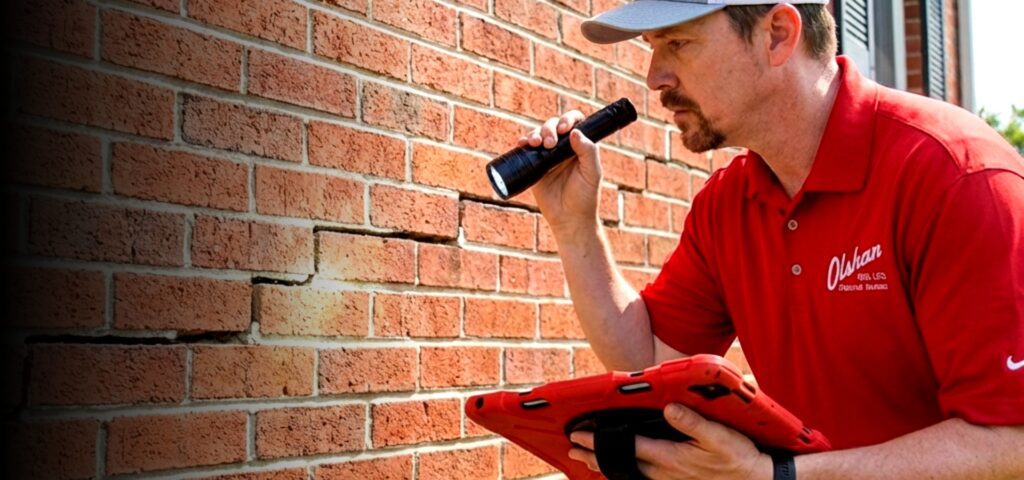
Most Texas foundation conversations start and end with expansive clay soil. San Marcos is more complicated. The Balcones Escarpment divides Hays County into two distinct environments: the Hill Country limestone terrain rising toward Wimberley and Blanco to the west, and the Black Prairie clay soils that dominate the I-35 corridor, the neighborhoods east of Texas State’s campus, and the areas stretching toward Kyle and Buda. On the limestone side, shallow bedrock constrains pier depth, slopes create drainage variables, and clay-filled pockets above the rock create unpredictable support conditions. On the clay side, the same expansive soil driving foundation repair across the Austin metro absorbs spring rain and swells, then contracts hard through the long Central Texas summer – a cumulative cycle that produces the cracked walls, sticking doors, and sloping floors that bring homeowners to Olshan. The San Marcos Springs, emerging from the Edwards Aquifer through the fault zone beneath the city, add a third layer: water table conditions near the river corridor behave differently than elsewhere, with moisture cycling implications specific to this geography.
The housing stock spans every era of that growth. The Belvin Street Historic District and the Victorian-era neighborhoods surrounding the Hays County Courthouse have been through more than 130 years of Hays County soil movement – many on original pier and beam foundations with crawl spaces that have never been properly managed. The mid-century slab homes spreading from the university campus through the 1960s and 70s are now 50 to 70 years old, entering the range where cumulative clay movement becomes structurally visible. And San Marcos’s ongoing growth – driven by a Texas State enrollment of 38,000-plus and sustained demand from Austin and San Antonio commuters – keeps putting new construction on recently disturbed soils across both the clay east and the variable limestone-clay west, where foundation symptoms can appear within the first few years of occupancy.
Foundation Repair: Cable Lock ST Plus vs Helical Piers, and How We Choose
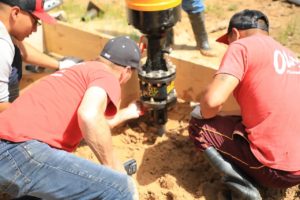
San Marcos sits at the junction of two soil environments, which means that foundation repair here sometimes requires a more deliberate conversation about pier selection than in markets where one system is clearly right for every situation. Olshan offers both our patented Cable Lock ST Plus system and helical piers, and we apply each where the conditions actually call for it.
Olshan’s Cable Lock ST Plus is our primary recommendation for most Central Texas slab foundation repair – and for good reason. The hybrid system drives concrete cylinders reinforced with steel cable to stable bearing soil below the active clay zone. In the expansive clay soils of San Marcos’s east and south sides, where the standard Texas shrink-swell cycle is the mechanism driving movement, Cable Lock ST Plus delivers stabilization with less disruption to landscaping and outdoor features than helical installation typically requires. The installation process is relatively compact, the equipment footprint is manageable in tight residential settings, and the cost structure is efficient – which matters when a Central Texas clay foundation may need eight, ten, or more piers to fully address differential settlement. The system also carries Olshan’s industry-leading available transferable warranty, which has real value in a university-influenced real estate market where homes change hands frequently.
Helical piers are screw-pile systems – steel shafts with helical plates that are mechanically rotated into the ground rather than driven. They’re genuinely excellent in the right application: structures that lack the dead load to drive conventional piers to refusal, situations where access constraints make larger installation equipment impractical, applications where the soil profile is unusual enough that the engineer’s recommendation is specifically helical, or commercial and industrial structures where load-transfer requirements call for engineered pier solutions. In San Marcos’s Hill Country-adjacent terrain, where shallow limestone bedrock complicates conventional pier driving and where some lots have access constraints that favor the helical installation method, helical piers are sometimes the right call.
The honest comparison: for the majority of residential slab foundations on the clay-dominant soils that make up the largest share of San Marcos’s housing stock, Cable Lock ST Plus provides equivalent or better long-term performance than helical piers at a lower total cost per repair, with less disruption to the property during installation, and with warranty coverage that the alternative rarely matches. We’re not interested in overselling the more expensive option when the more cost-effective one is the better fit. When the situation calls for helical piers – and some do – that’s what we’ll recommend. When it doesn’t, we’ll tell you that too.
Every evaluation begins with a thorough evaluation. Our Certified Structural Technicians look at the specific soil conditions of your lot, the construction era of your home, the pattern and location of movement symptoms, and the drainage environment around the foundation before making any recommendation at all. About 20% of the homes we inspect don’t need repair – and that’s what you’ll hear from us when it’s the case.
Signs of active foundation movement in San Marcos homes:
- Diagonal drywall cracks that open wider in dry summers and partially close after spring rains – the seasonal signature of active clay movement in eastern San Marcos
- Stair-step brick cracking on homes near the Hays County Courthouse historic districts where Victorian-era foundations have been through over a century of soil cycling
- Floor slope that has been developing gradually in mid-century slab homes east of the Texas State campus
- Doors and windows in newer Hill Country-adjacent construction that bind at specific points related to uneven settling on variable limestone-clay soils
- Visible soil gaps at the foundation perimeter in late summer after extended dry periods on Black Prairie soils
- New cracks appearing in homes less than five years old on recently disturbed fill soil in San Marcos’s active development corridors
Crawl Space Repair – Pier and Beam Homes

San Marcos’s historic neighborhoods contain a meaningful inventory of pier and beam homes – structures built before concrete slab became the dominant construction method in Central Texas. The crawl spaces beneath these homes are often unprotected, unencapsulated, and in some cases have been accumulating moisture and structural deterioration for decades without any intervention. In a climate that cycles between wet springs and brutally dry summers, with live oaks, cedars, and pecans drawing additional moisture from the soil around and beneath foundations during dry periods, the conditions beneath an unmanaged pier and beam crawl space are consistently hostile to wood.
Olshan’s crawl space repair services address what’s actually there. We replace or reinforce deteriorating support posts, apply Lumberkote wood preservative to existing structural timber to arrest active decay and inhibit future moisture uptake, install vapor barrier encapsulation to control ground moisture, and address any drainage conditions that are contributing to the problem from below. For historic Belvin Street-area homes and similar vintage structures, proper crawl space maintenance isn’t optional – it’s what keeps a 130-year-old house standing for the next 130 years.
Concrete Leveling – PolyLift
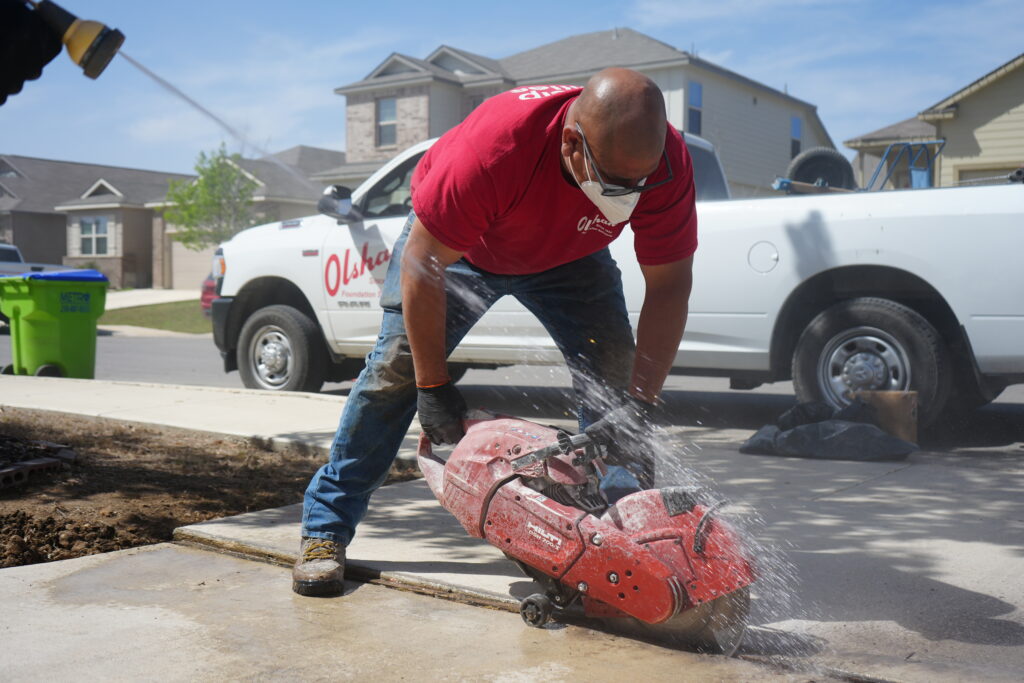
Settled and sunken concrete is a consistent presence throughout San Marcos – in the established neighborhoods where decades of clay movement have worked on flatwork, in the areas near the San Marcos River where moisture conditions are more variable, and in newer commercial and residential developments where fill soil consolidation has dropped slabs in the first years after construction. What changes in San Marcos versus a flat suburban market is the variety of structures and applications where PolyLift provides value.
On the residential side: driveways, walkways, patio slabs, pool decks, and porch approaches throughout the city’s established neighborhoods and newer subdivisions. These are the predictable applications. In a university city with a significant commercial and retail base along I-35, Cypress Creek Road, and the Outlet areas, PolyLift also serves commercial properties – warehouse and distribution facility floors where differential settlement from fill soil has created operational hazards, retail storefront approaches with settled entry slabs, restaurant and hospitality property flatwork, parking lot sections, and municipal sidewalk infrastructure. The mechanism is the same regardless of the application: high-density polyurethane foam fills the voids, lifts the surface, and cures in minutes with no heavy equipment on the surrounding area. The scale and complexity of commercial applications may vary, but the efficiency advantage over conventional replacement is consistent across all of them.
Exterior Water Management
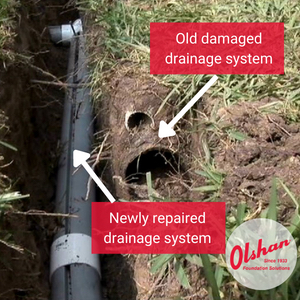
Water is the mechanism that drives almost everything Olshan addresses in San Marcos. On the clay-dominant east side, water that doesn’t drain away from the foundation efficiently keeps soil moisture elevated and forces the shrink-swell cycle to work harder than it would naturally. On the Hill Country-adjacent west side, water moving rapidly across limestone-over-clay lots can channel toward structures in ways that weren’t anticipated in the original site design. And throughout the city, the rapid growth of the past decade has produced residential subdivisions where grading was done quickly, drainage infrastructure was sized for minimum code compliance, and the long-term drainage behavior of lots hadn’t been fully considered.
Olshan evaluates each property’s specific drainage conditions and installs targeted solutions. French drains intercept and redirect runoff before it accumulates against the foundation. Surface channel systems manage the concentrated roof runoff that Hays County’s periodic heavy rain events can produce. Lot regrading reestablishes positive drainage slope away from the structure where original grading has shifted. For properties on San Marcos’s hillier west-side terrain, drainage design accounts for the slope-driven runoff behavior that flat-lot solutions don’t adequately address.
Prevention – Two Systems That Work Before Problems Start
San Marcos’s combination of clay soil, limestone terrain variability, and a climate that swings between wet springs and extended dry summers makes proactive foundation protection particularly valuable. The most expensive repairs we do are the ones where problems have been developing for years without intervention. The least expensive outcomes are the ones where homeowners stay ahead of conditions before structural damage accumulates.
Drought Defense Foundation Watering System
The dry season in Central Texas is the period when San Marcos foundations take the most cumulative damage. When Hays County’s clay soils lose moisture through summer heat and evaporation, they pull away from foundation perimeters – removing the lateral support that keeps slabs stable and creating the conditions for differential settlement. In years when the Austin-San Antonio corridor sees extended drought, the contraction can be severe enough to produce visible soil gaps around foundations that have never previously shown problems.
Olshan’s Drought Defense System installs an automated perimeter watering solution that maintains consistent soil moisture through dry periods. It’s not about keeping the soil saturated – it’s about preventing the extreme contraction that does structural damage. For San Marcos homeowners on the Black Prairie clay soils of the eastern city, for new construction still settling into reactive soil, and for any home that has already shown movement symptoms, Drought Defense addresses the most damaging part of Central Texas’s annual climate cycle before it has a chance to do its work.
Foundation Monitoring System
San Marcos is a city where foundations move – sometimes slowly and seasonally, sometimes more progressively. A one-time evaluation tells you what’s happening at a single point in time. The monitoring system tells you what’s actually happening to your foundation over months and years, which is the information that most clearly distinguishes between normal seasonal movement that doesn’t require intervention and progressive settlement that does.
Elevation sensors placed at key structural points around your home continuously track movement and transmit data that Olshan’s team can evaluate for developing trends. For homeowners with prior repairs who want to verify that the work is holding, for new construction on San Marcos’s variable soils where early movement is worth catching before it escalates, and for anyone preparing to sell in a market where foundation history is a common point of buyer scrutiny – monitoring provides documented, credible performance data that a single evaluation simply cannot.
Serving San Marcos and the Central Texas Corridor
Olshan serves San Marcos and the communities along the I-35 corridor connecting Austin and San Antonio – including Kyle, Buda, New Braunfels, Wimberley, and across Hays, Caldwell, and Guadalupe Counties. We’ve been repairing foundations in this part of Central Texas since 1933, and we’ve built our understanding of the Balcones transition zone geology, the Hill Country limestone terrain, and the Black Prairie clay conditions that define the foundation environment throughout this region over generations of hands-on work here.
Contact Olshan today to schedule your free, no-obligation foundation evaluation in San Marcos, TX.