
Trusted Foundation Repair in Marshall, TX
Marshall is one of East Texas’s most historically significant cities – the county seat of Harrison County since 1842, a community whose roots run deeper than most Texas cities and whose neighborhoods reflect more than 150 years of continuous residential development. From the antebellum and Victorian homes radiating out from the historic courthouse square along Rusk and Houston streets, to the railroad-era neighborhoods north of Grand Avenue built for Texas and Pacific Railway workers, to the mid-century residential growth along U.S. 59 and the newer homes spreading south toward Interstate 20, Marshall carries its history in its architecture and in the ground beneath it.
That ground is the common thread connecting every era of Marshall’s housing stock – Harrison County’s clay-rich soil, which has been working against foundations here since the first permanent structures were built in the 1840s. Olshan has been repairing foundations across East Texas and the greater region since 1933. We understand what this specific soil, this specific climate, and this specific combination of rainfall and summer heat do to a home’s structural foundation – and we know how to fix it.
Why Harrison County Soil Creates Such Demanding Foundation Conditions
Marshall sits squarely in the piney woods of Northeast Texas, in a climate that receives approximately 51 inches of rain annually – significantly more than most of the state. That rainfall, distributed unevenly across wet springs and dry summers, creates the moisture cycling conditions that are most destructive to foundations built on clay soil. And in Harrison County, clay soil is essentially everywhere.
The soils throughout this part of Northeast Texas contain heavy concentrations of expansive clay that swell under wet conditions and contract aggressively during dry periods. Unlike the Gulf Coast’s Beaumont clay formation to the south, Harrison County’s soils sit in a forest environment where a dense population of mature pine, water oak, and sweet gum trees adds a variable that most Texas counties don’t face to the same degree: aggressive root systems that actively extract moisture from the soil around and beneath foundations during dry periods, accelerating soil contraction in localized zones directly adjacent to structures.
The result is an environment where foundations experience both the standard shrink-swell cycle driven by seasonal rainfall variation and an additional moisture-extraction problem driven by East Texas’s tree canopy. The combination produces differential movement – one section of a foundation losing soil contact while another remains supported – that is responsible for the diagonal cracks, racked door frames, and separating walls that are common presentations in Marshall’s older homes.
Marshall also averages more than 230 frost-free days per year, meaning soil activity never truly pauses the way it might in more northern climates. The clay is cycling moisture in some form year-round, and the cumulative stress on foundations over decades is correspondingly higher than in regions where cold winters provide a natural period of soil stabilization.
Marshall’s Homes and What They’re Up Against
Few Texas cities of Marshall’s size have a housing stock as historically layered as this one. The neighborhoods radiating out from the courthouse square include some of the oldest continuously occupied residential structures in East Texas – antebellum-era homes, Victorian cottages, and late 19th-century frame houses that predate most of the state’s current building practices by generations. These structures were built long before modern foundation engineering existed, and many have been through more than a century of Harrison County’s aggressive soil movement.
The railroad-era neighborhoods north of U.S. 80, built primarily for Texas and Pacific Railway employees from the 1870s through the early 20th century, represent a dense inventory of older pier and beam homes whose crawl spaces have been exposed to East Texas humidity for 80 to 100 years or more. The New Town neighborhood on the southwest side of the city, developed around Wiley College and home to some of Marshall’s most historically significant African American architecture, contains comparable vintage structures facing comparable foundation challenges.
Mid-century slab construction spread south and west of downtown through the 1950s, 60s, and 70s, producing a large inventory of concrete slab homes now 50 to 70 years old – old enough that the clay soil beneath them has been through many cycles of movement, and cast iron drain lines beneath many of these slabs are approaching or past the end of their useful life. Newer residential development near Interstate 20 and along the Highway 59 corridor has brought more recent construction into the mix, but newer doesn’t mean immune – Marshall’s clay soil affects foundations on a timeline measured in years, not decades.
Foundation Repair in Marshall – Olshan’s Cable Lock ST Plus System
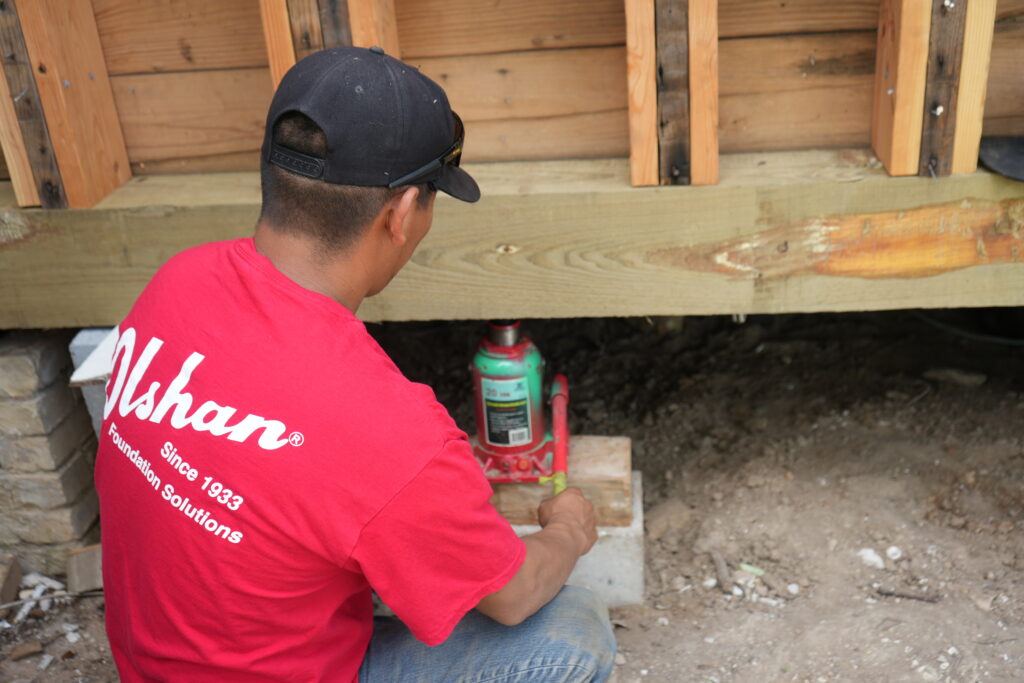
Foundation repair is Olshan’s primary service in Marshall, and our patented Cable Lock ST Plus pier system is designed precisely for the kind of expansive clay conditions that define Harrison County soil. The system drives hybrid concrete and steel piers through the active clay zone – the depth range where seasonal moisture changes cause soil to expand and contract – and anchors them in stable bearing soil below. Once installed, movement stops. The cracks that opened during years of differential settlement can be addressed, structural integrity is restored, and the repair is backed by an industry-leading transferable warranty that stays with the home.
Marshall’s housing stock includes a wide range of foundation types, construction eras, and soil exposure histories. Our Certified Structural Technicians evaluate each situation individually – taking into account whether the home is pier and beam or slab, the age of the structure, the presence of mature trees in proximity to the foundation, and the specific drainage conditions of the lot – before recommending a solution. We also offer helical piers for applications where soil conditions or access constraints make conventional driven piers the wrong choice, and pressed concrete pilings for situations where cost-effective stabilization is the primary objective.
What it fixes:
- Diagonal cracks through plaster and drywall in Marshall’s older railroad-era and Victorian-era homes
- Door and window frames racked out of square by decades of Harrison County clay movement
- Foundation settling beneath antebellum and historic district structures on heavily treed lots
- Slab differential movement in mid-century homes south and west of downtown Marshall
- Brick veneer cracking on East Texas Baptist University-area and Wiley College-area homes
- Structural instability driven by moisture extraction from mature East Texas pine and oak root systems
Additional Services Olshan Offers in Marshall
Crawl Space Recovery and Encapsulation
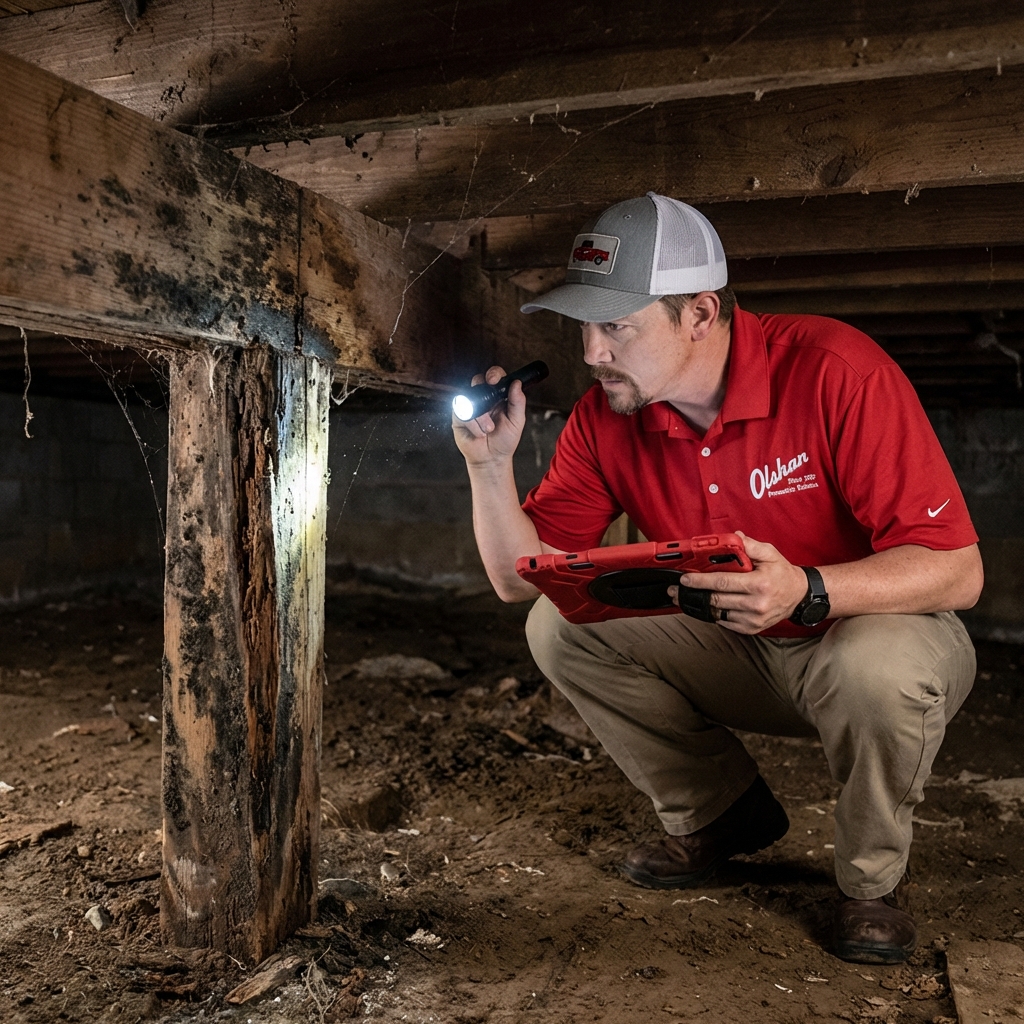
Marshall’s railroad-era neighborhoods contain some of the most moisture-challenged crawl spaces in East Texas. Pier and beam homes built for Texas and Pacific Railway workers in the late 1800s and early 1900s were constructed with the materials and methods of their era – wood pier systems that have now been in the ground for over a century, in a climate that delivers 51 inches of rain annually and maintains high ambient humidity for most of the year. The East Texas pine and hardwood forests that give Marshall its distinctive character also mean that organic material accumulates in crawl spaces, fungal growth finds ideal conditions, and wood decay progresses faster than in drier parts of the state.
What we typically find when we access the crawl spaces of Marshall’s older pier and beam homes is a combination of problems that compound each other: wood piers that have rotted at their base where they contact the soil, joists that have lost structural integrity from years of moisture cycling, ground moisture that has never been controlled, and in many cases active mold that has been sending spores into the living space above for years. Olshan’s crawl space recovery program is designed to address all of these problems in sequence – stabilizing the structure first, then treating and preserving remaining wood with Lumberkote, then installing a complete vapor barrier encapsulation system that seals the crawl space from the moisture environment that created the problem in the first place.
What it fixes:
- Century-old pier and beam supports in Marshall’s railroad-era neighborhoods deteriorated by East Texas humidity
- Wood rot at pier bases where ground contact in Harrison County’s wet soil has accelerated decay
- Fungal growth on structural wood encouraged by unmanaged crawl space moisture in the piney woods climate
- Uneven and bouncy floors above crawl spaces where joists have lost load-bearing capacity over time
- Mold spore migration from unencapsulated crawl spaces into living areas of historic Marshall homes
- Pest access points at the crawl space perimeter in homes where the original foundation skirting has failed
Exterior Water Management
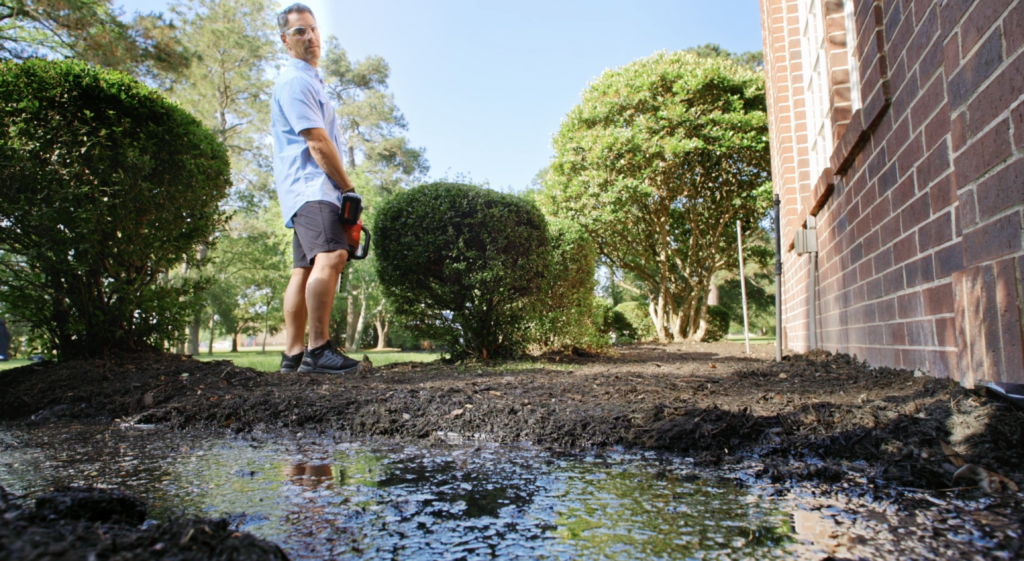
At 51 inches of annual rainfall, Marshall receives more precipitation than almost any major city in Texas. That rain doesn’t distribute itself evenly across the calendar – it concentrates in wet spring periods and then gives way to dry East Texas summers where the clay soil contracts and the trees pull additional moisture out of the ground. The drainage infrastructure of Marshall’s older neighborhoods was designed for a different era and often a different understanding of what sustained moisture against a foundation does over time. Mature tree root systems have spent decades reshaping subsurface drainage patterns in ways no original site plan anticipated. Lots that graded away from structures when they were first built may now slope toward them as soil has settled and landscaping has matured around the perimeter.
The result is that many Marshall homeowners are dealing with a drainage situation that has deteriorated gradually and invisibly over years. Water that once moved away from the foundation now finds its way back to it, keeping the perimeter soil saturated during wet periods and contributing to the differential moisture conditions that cause the most damaging foundation movement. Olshan evaluates each property’s specific drainage behavior – where water enters the lot, where it accumulates, and what path it takes toward or away from the structure – and installs targeted solutions including French drains, surface channel systems, downspout extensions, and precision lot regrading that redirect water permanently.
What it fixes:
- Perimeter drainage failure in Marshall neighborhoods where mature tree roots have reshaped subsurface water movement
- Water accumulation against historic home foundations after Harrison County’s frequent and heavy spring rainfall events
- Lot grading that has shifted over decades of soil settlement in Marshall’s oldest residential areas
- Downspout discharge concentrating roof runoff at foundation corners on older East Texas homes without proper extensions
- Chronically saturated clay soil against foundation perimeters keeping moisture-driven expansion pressure elevated year-round
Concrete Leveling – PolyLift
The same clay soil and root system activity that damages Marshall’s foundations also works steadily against its flatwork. In the historic neighborhoods near downtown, driveways and walkways have been through generations of East Texas wet-dry cycles, and the void formation that occurs when Harrison County’s clay contracts beneath concrete is compounded by root growth that both displaces slabs from below and extracts moisture from the supporting soil. The result is flatwork that heaves, drops, and tilts in ways that reflect the specific moisture history of each individual section of ground beneath it.
In Marshall’s older residential areas, full concrete replacement is rarely the right answer – the underlying soil conditions that caused the problem haven’t changed, and new concrete will respond to them the same way the old concrete did. Olshan’s PolyLift system addresses the actual mechanism of failure: high-density expanding foam injected through small ports fills the voids that clay contraction and root activity have created beneath the slab, lifts the surface back toward its original elevation, and provides a stable base that doesn’t depend on the clay soil remaining at a consistent moisture level. The process is completed in hours, requires no heavy equipment on the property, and produces no excavation damage to surrounding landscaping – an important consideration in Marshall’s heavily planted historic neighborhoods.
What it fixes:
- Walkways and drives in Marshall’s historic district displaced by a combination of clay cycling and century-old tree root systems
- Entry steps and porch slabs settled away from Victorian and Craftsman-era homes in the downtown corridor
- Driveway sections in railroad-era neighborhoods dropped by void formation under East Texas shrink-swell conditions
- Sidewalk panels lifted unevenly by pine and water oak root growth beneath concrete in heavily canopied Marshall streets
- Patio slabs and outdoor concrete tilting toward structures and directing Harrison County’s significant rainfall at foundation perimeters
Warning Signs Marshall Homeowners Should Know
In a city with Marshall’s housing age profile, it’s tempting to attribute foundation symptoms to general age and settle-in rather than to active soil movement. That’s a mistake that tends to get more expensive over time. The warning signs below indicate that soil movement is occurring – not that a home is simply old. Watch for any of the following:
- Diagonal cracks through plaster or drywall at door and window corners – a reliable indicator of differential foundation movement
- Stair-step cracking through exterior brick mortar joints on homes in Marshall’s historic neighborhoods
- Doors that have progressively become harder to open and close, particularly in rooms closest to large trees
- Floors that feel noticeably springy or that slope visibly toward one end of a room
- Gaps appearing between baseboards and floors, or between crown molding and ceilings
- Visible separation between a porch or addition and the main structure of an older home
- Musty or earthy odors from beneath the floor in pier and beam homes – an indicator of crawl space moisture problems
- Persistent slow drains throughout a slab home with no obvious plumbing blockage source
Serving Marshall and Harrison County
Olshan serves Marshall and the surrounding communities of Harrison County – including Longview, Tyler, Kilgore, Henderson, Carthage, Jefferson, and the broader East Texas region along the Interstate 20 and Highway 59 corridors. We’ve been repairing foundations across this part of Texas since 1933, and we bring the full depth of that experience to every home we evaluate in Marshall.
A free, no-obligation foundation inspection is where we start. Our Certified Structural Technicians will walk your property, assess your foundation, explain what they find in plain language, and give you an honest recommendation. We don’t find repairs that aren’t needed – about 20% of the homes we inspect don’t require any repair at all, and we’ll tell you that clearly when that’s the case.
Contact Olshan today to schedule your free foundation inspection in Marshall, TX.