
Foundation Repair in Missouri City, TX
Missouri City is one of Fort Bend County’s most established and well-regarded communities – a suburb with real history, strong schools, and a housing stock that spans more than five decades of residential development. From Quail Valley, one of the first master-planned communities in the entire Houston region when it opened in 1969, to the sprawling master-planned developments of Sienna and Riverstone, to the luxury enclaves of Colony Lakes and Lake Olympia, Missouri City offers a range of neighborhoods and home types that draw families from across the greater Houston metro.
What connects all of them, regardless of age or price point, is the Fort Bend County clay soil sitting beneath their foundations. Olshan has been repairing foundations across Greater Houston since 1933, and we’ve worked in Missouri City and the communities surrounding it for generations. We know what this soil does, how the weather accelerates it, and how to fix it properly and permanently. If your home is showing signs of foundation movement, or if you simply want to know where things stand before they become a bigger problem, we’d like to help.
What Makes Missouri City’s Soil So Hard on Foundations
Missouri City sits in the heart of the Beaumont clay formation – the same deep deposit of highly expansive Gulf Coast clay that makes foundation repair one of the most common home services across the entire Greater Houston area. This clay swells significantly when it absorbs moisture during periods of heavy rainfall and contracts just as dramatically when heat and drought pull that moisture back out. The shrink-swell cycle that results is the primary driver of foundation movement across Fort Bend County, and Missouri City homeowners have been living with its effects since the first neighborhoods were built here in the late 1960s.
Fort Bend County’s naturally flat terrain and the high water table in many areas mean that moisture doesn’t always drain efficiently away from foundations – it lingers in the soil, keeping pressure on slab edges and pier footings for extended periods after rain events. Missouri City also sits in a zone where land subsidence from decades of regional groundwater extraction has contributed measurable ground-level settlement in parts of the area. That’s a separate mechanism from clay movement, but it compounds the foundation stress that expansive soil already creates.
The Southwest Houston area is also no stranger to intense tropical weather. When rapid, heavy rainfall saturates already-stressed clay soil, the resulting pressure on foundation slabs can be significant – and the dry periods that follow only deepen the shrink-swell cycle that does long-term structural damage.
Missouri City’s Neighborhoods and What They’re Up Against
Missouri City’s housing stock tells the story of five decades of Fort Bend County growth, and each era of construction presents its own foundation vulnerabilities.
Quail Valley – developed beginning in 1969 and largely built out through the 1970s and 1980s – is one of the oldest master-planned communities in the Houston region. Homes here are 40 to 55 years old, built on foundations that have endured decades of clay movement, seasonal moisture swings, and in many cases, cast iron plumbing beneath the slab that is at or past the end of its service life. Foundation cracking, settled concrete flatwork, and sub-slab plumbing failures are all common presentations in Quail Valley and surrounding neighborhoods of similar vintage like Buffalo Run and Lake Olympia.
Mid-generation communities built through the 1990s and 2000s – Colony Lakes, portions of Riverstone, and the earlier sections of Sienna – represent Missouri City’s broadest inventory. These homes are entering the age range where foundation issues most commonly become visible, as the cumulative effects of soil movement and drainage patterns that weren’t properly established at construction begin to show up in walls, floors, and door frames.
Sienna – Missouri City’s largest master-planned community with nearly 14,000 residents – spans a wide range of construction vintages from the early 2000s through active new builds today. Newer sections of Sienna face the same challenge as other rapidly developed Fort Bend County communities: foundations placed on recently disturbed fill soils that are still consolidating and responding to their first years of Gulf Coast weather cycles. A home in Sienna that passed inspection at closing can develop early movement symptoms within two or three summers.
Riverstone, known for its luxury homes and gated communities across 3,800 acres, sits on the same Fort Bend clay as every other neighborhood in the area. Higher price points don’t change what the soil does.
Foundation Repair in Missouri City – Olshan’s Cable Lock ST Plus System
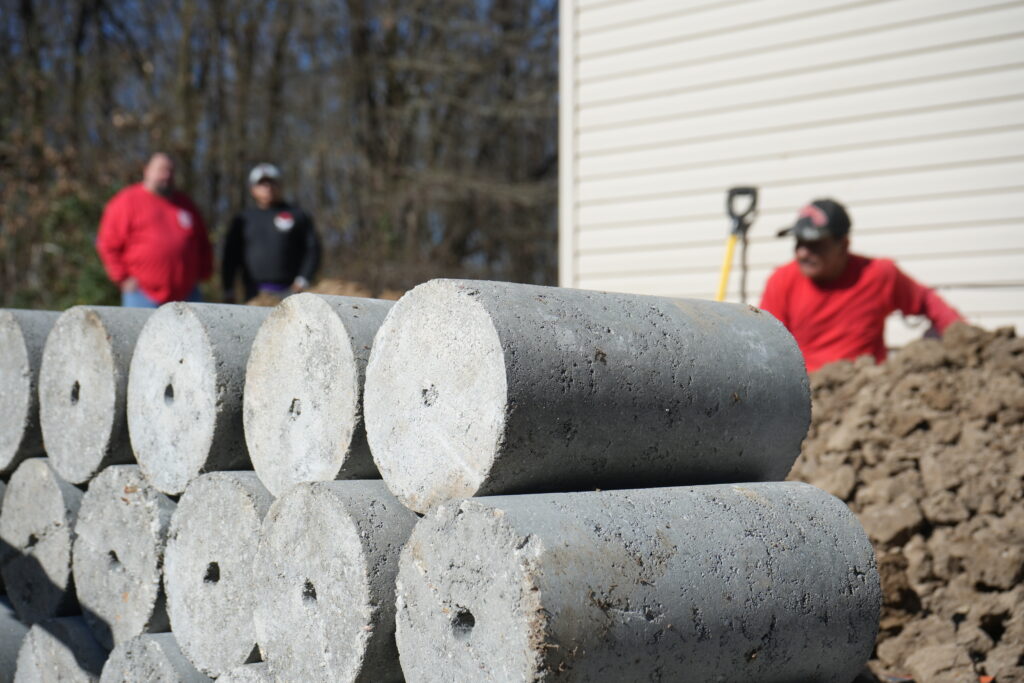
Foundation repair is Olshan’s core service, and our patented Cable Lock ST Plus pier system is the most proven solution for the Beaumont clay conditions throughout Fort Bend County. Our hybrid piers combine the load-bearing capacity of concrete with steel cable reinforcement, driven deep through the active clay zone to stable soil below where moisture fluctuations drive movement. The result is permanent foundation stabilization – movement stopped, cracks addressed, structural integrity restored – backed by an industry-leading transferable warranty.
No two foundations are the same. Our Certified Structural Technicians evaluate your home individually and recommend the right solution for your specific conditions – whether that’s Cable Lock ST Plus, helical piers for specialized applications, or pressed concrete pilings. We recommend what’s right, not what’s most expensive.
What it fixes:
- Foundation settling specific to Fort Bend County’s Beaumont clay formation
- Stair-step brick cracks and diagonal drywall fractures common in Quail Valley-era homes
- Doors and windows in older Missouri City slab homes racked out of square by soil movement
- Uneven floors in Sienna and Riverstone homes on recently disturbed fill soil
- Slab differential movement driven by the area’s high water table
- Structural instability in homes affected by measurable Fort Bend County subsidence
Additional Services Olshan Offers in Missouri City
Crawl Space Recovery and Encapsulation

Pier and beam homes in Missouri City’s older sections carry a specific vulnerability that slab homes don’t: an open, unprotected crawl space sitting in one of the most humid counties in Texas. Fort Bend County’s combination of high water table, clay-heavy soil, and Gulf Coast humidity creates conditions beneath these homes that accelerate wood decay, foster mold growth, and compromise structural supports over time – often without a single visible symptom above the floor. By the time bouncy floors or musty odors appear, the damage underneath is typically significant. Olshan’s crawl space recovery program goes well beyond a vapor barrier install. We assess the full structural condition below, replace or sister deteriorating posts, apply Lumberkote wood preservative to existing timber, install a complete encapsulation system, and address air quality issues that have been migrating upward into the living space.
What it fixes:
- Deteriorating support posts in pier and beam homes in older Missouri City sections
- Subfloor decay accelerated by Fort Bend County’s chronically high humidity levels
- Mold growth on structural wood in crawl spaces with inadequate ground moisture control
- Musty air migrating from an unencapsulated crawl space into living areas above
- Soft or bouncy floor sections above failing pier and beam supports
- Pest entry points created by open, unprotected crawl space perimeters
Exterior Water Management
Fort Bend County’s terrain is relentlessly flat, and in Missouri City that flatness creates a drainage environment where water doesn’t move unless it’s directed somewhere specific. On a lot with even slightly negative grading – a condition that develops naturally as soil settles and landscaping matures – water from rain events accumulates against the foundation rather than away from it. In Beaumont clay, that pooled water doesn’t absorb quickly. It sits against the slab edge, keeps the soil in a saturated, expanded state for days, and applies lateral pressure that works against your foundation continuously. Older neighborhoods like Quail Valley have had decades for drainage patterns to drift; newer sections of Sienna were sometimes graded quickly and imprecisely. Either way, the result is the same. Olshan evaluates your specific lot conditions and installs targeted solutions – French drains routed to proper outfalls, surface channel systems, downspout extensions, and precision regrading – that fix the drainage problem at the source.
What it fixes:
- Water pooling against slab edges on Fort Bend County’s characteristically flat lots
- Drainage patterns in Quail Valley and older neighborhoods that have drifted over decades
- Imprecise grading in newer Sienna sections directing runoff toward the structure
- Downspouts depositing concentrated roof runoff at the foundation perimeter
- Chronically saturated Beaumont clay keeping lateral pressure on slab edges year-round
Concrete Leveling – PolyLift
In Missouri City’s Quail Valley and surrounding neighborhoods, driveways and flatwork installed in the 1970s and 1980s have been through fifty-plus years of Fort Bend clay movement. The void formation that occurs when Beaumont clay contracts during dry periods is what drops concrete – not gradual settling, but sudden loss of support from below. Pool decks in Riverstone and Sienna, sidewalks throughout Colony Lakes, garage floors in Buffalo Run – all of them are subject to the same mechanism. What looks like a cracked or tilted slab on the surface is usually a void problem below it. Olshan’s PolyLift system addresses that directly: high-density polyurethane foam is injected through small ports into the void space, expanding to fill it completely and lifting the slab back toward level. There’s no curing wait, no heavy equipment on the property, and no excavation.
What it fixes:
- Driveways in Quail Valley and Buffalo Run dropped by decades of Beaumont clay contraction
- Pool deck sections in Riverstone and Sienna settled unevenly into subsurface voids
- Garage floor slabs separating from the threshold in Missouri City’s older slab homes
- Sidewalk panels in Colony Lakes and Lake Olympia lifted and dropped by clay cycling
- Patio and outdoor slab areas tilting toward the home and directing water at the foundation
Under-Slab Plumbing and Tunneling
Quail Valley was developed beginning in 1969. That means the cast iron drain lines beneath many of its slab homes have been in the ground for more than 50 years – in Fort Bend County’s moisture-saturated soil environment, where corrosion rates are higher than in drier parts of Texas. A failing pipe beneath a slab doesn’t announce itself with a dramatic event. It announces itself slowly: a drain that backs up more often than it used to, a faint sewage smell that comes and goes, a foundation that continues moving after a repair that should have stopped it. The connection between the pipe and the foundation problem often goes undiagnosed for years because the two symptoms don’t obviously point to each other. Olshan identifies the source through careful diagnostic work, then accesses the failed pipe by tunneling beneath the slab rather than breaking through it – a critical distinction that protects your foundation from additional stress during the repair process.
What it fixes:
- Cast iron drain lines beneath Quail Valley slab homes corroded after 50-plus years in Fort Bend soil
- Sub-slab moisture intrusion in Buffalo Run and Lake Olympia driving unexplained foundation movement
- Recurring drain backups in Missouri City homes built in the 1970s, 1980s, and 1990s
- Voids forming in Beaumont clay beneath the slab from a slow, undetected pipe leak
- Foundation repairs that failed to hold because the underlying plumbing source wasn’t addressed
Home Elevation
For Missouri City homeowners in areas that have experienced repeated flood damage or that lie within designated flood zones, Olshan offers structural home elevation up to 22 feet. Elevating a home above base flood elevation can eliminate or dramatically reduce future flood damage risk and often results in meaningful flood insurance premium reductions. Our team has elevated hundreds of homes across the greater Houston area and brings that experience directly to Fort Bend County homeowners who need a permanent solution to a recurring problem.
Prevention – Stop Problems Before They Start
The best foundation repair is the one you never need. Olshan offers two systems designed specifically to prevent the conditions that drive foundation damage in Missouri City’s clay soil environment.
Drought Defense Foundation Watering System
The pattern is predictable in Fort Bend County: spring rains saturate the Beaumont clay, the soil expands, and then summer arrives with weeks of heat and no meaningful rainfall. The clay contracts, and in that contraction it pulls away from whatever it was supporting – including the perimeter of your foundation. For Quail Valley homes that have been through this cycle 40 or 50 times, the soil around the foundation has a memory of where those gaps form and reopens them faster with each passing year. For newer Sienna homes, the cycle is compressing years of soil adjustment into a few intense Texas summers. Olshan’s Drought Defense System places a perimeter watering solution around your foundation that activates automatically during dry periods, keeping the moisture content in the soil adjacent to your slab or pier footings within the stable range – preventing the contraction that drives the most common form of foundation damage in this area.
What it prevents:
- Perimeter soil contraction pulling away from Quail Valley and Buffalo Run slab foundations during summer
- Gap formation at the foundation edge that accelerates with each shrink cycle in older Fort Bend homes
- Rapid soil adjustment compressing years of movement into the first few summers in newer Sienna construction
- Recurrent seasonal cracking that reopens predictably every dry season without moisture management
Foundation Monitoring System
Missouri City has neighborhoods at every stage of foundation risk – from Quail Valley homes with decades of movement history to Sienna new construction still finding its footing in Fort Bend clay. For homeowners in either situation, a one-time inspection answers the question of where things stand today. The monitoring system answers the more important question: what is the foundation actually doing over time? Elevation sensors installed at key points around the structure transmit ongoing data that allows Olshan’s team to identify movement trends early – before they’ve progressed to visible cracking, sticking doors, or floor deflection. For homeowners who’ve had prior repairs, the system confirms those repairs are holding. For those approaching a sale, it provides documented performance history that a buyer’s inspector cannot dispute.
What it provides:
- Longitudinal elevation data across Missouri City homes at all stages of foundation risk
- Early movement identification in Sienna new construction before symptoms become visible
- Post-repair stability confirmation for Quail Valley and older Fort Bend County homes
- Transferable performance documentation with real value in Missouri City’s competitive resale market
Warning Signs Missouri City Homeowners Should Know
Foundation movement in Missouri City develops gradually and the early signs are easy to explain away. In Fort Bend County’s clay environment, problems that start small don’t tend to resolve on their own. Watch for any of the following:
- Cracks in drywall or ceilings – especially diagonal cracks at door and window corners
- Stair-step cracks in exterior brick or mortar joints
- Doors or windows that stick, bind, or no longer close or latch properly
- Gaps opening between walls and ceilings or floors and baseboards
- Floors that feel uneven, springy, or soft underfoot
- Visible gaps between soil and the foundation perimeter after a dry summer
- Standing water pooling near the foundation after rain
- Slow or chronically backing-up drains in homes built before 2000
Serving Missouri City and Southwest Houston
Olshan’s Houston team serves all of Missouri City and the Fort Bend County communities that surround it – including Sugar Land, Stafford, Pearland, Fresno, Richmond, Rosenberg, and the broader southwest Houston corridor. Within Missouri City, we work regularly in Quail Valley, Sienna, Riverstone, Colony Lakes, Lake Olympia, Buffalo Run, Dry Creek Village, and throughout the city’s established and newer neighborhoods alike.
Greater Houston is where Olshan started in 1933, and Fort Bend County has been part of our service territory for decades. If you’re seeing signs of foundation movement – or if you want a professional evaluation before problems develop – we’d like to earn your confidence starting with a free, no-obligation inspection. Our Certified Structural Technicians will assess your home, explain what they find clearly, and give you an honest recommendation. About 20% of the homes we visit don’t need repair at all – and we’ll tell you that too.
Contact Olshan today to schedule your free foundation inspection in Missouri City, TX.